5K Race Morning Schedule: Hour-by-Hour From Wake-Up to Gun
For a 9:00am 5K gun time: alarm at 6:30am, eat by 6:45am, leave by 8:00am, arrive by 8:20am, warm up from 8:35am, at the start line by 8:55am — a fixed 2.5-hour sequence from wake to gun. Below: how to calculate your own version of this schedule, the nutrition window, travel and arrival, the warm-up window, and contingency plans for when something goes wrong.
Compress that 2.5 hours because the alarm felt early, and the shortcuts don't announce themselves — they show up as a warm-up you rushed, a breakfast that's still digesting at the gun, a start line you reached out of breath before the race even began.
Calculating Your Schedule — The 2.5-Hour Rule
Count back 2.5 hours from gun time to get your wake-up time. That baseline assumes: 30 minutes to eat and get ready after waking, 60 minutes for digestion and logistics at home, 20 minutes travel, and 40 minutes at the venue before gun. Adjust travel time if the venue is further. Never reduce below 30 minutes of venue time before the gun.
If you're a slow digester — food sits uncomfortably for 90+ minutes post-meal — count back 3 hours and eat first thing on waking, before anything else.
| Gun time | Wake up | Eat by | Leave by | Venue arrival | Warm-up start |
|---|---|---|---|---|---|
| 7:30am | 5:00am | 5:10am | 6:30am | 6:50am | 7:05am |
| 8:00am | 5:30am | 5:45am | 7:00am | 7:20am | 7:35am |
| 9:00am | 6:30am | 6:45am | 8:00am | 8:20am | 8:35am |
| 10:00am | 7:30am | 7:45am | 9:00am | 9:20am | 9:35am |
| 11:00am | 8:30am | 8:45am | 10:00am | 10:20am | 10:35am |
All times assume 20-minute travel. Add directly for longer journeys — if your venue is 45 minutes away, leave 25 minutes earlier than the table shows. Do not compress the venue time to compensate for a longer commute.
What to Eat and When — The 5K Nutrition Window

The 5K-specific nutrition point that no competitor covers: a 5K doesn't require the glycogen loading of a marathon. The event is glycogen-dependent (especially for faster runners) but short enough that race-morning nutrition is about stable blood sugar and no GI distress — not topping up glycogen stores that were filled by your normal diet over the previous 24 hours.
What to eat: 300–400 calories, carbohydrate-forward, low fibre, low fat. Reliable options: toast with peanut butter and banana; oats with honey; a bagel with cream cheese. Familiar foods only — this is not the morning to test a new gel or pre-workout.
Timing: 1.5–2 hours before gun. Faster runners (sub-20) benefit from closer to 2 hours because higher intensity amplifies GI sensitivity — blood is diverted from the gut earlier and more completely. Slower runners (25–35 minutes) can eat at 1.5 hours without issue.
Coffee: if it's a daily habit, have it as normal immediately on waking — it counts as part of the eating window. Don't introduce it for the first time; GI effects under race-day stress can be more pronounced than in training conditions.
Hydration: 500ml water over the 2 hours before gun. Stop deliberate large water intake 30–60 minutes before the race to reduce the toilet urgency problem at the start line.
What to avoid: high-fibre breakfast (bran, beans, raw vegetables — the most common GI emergency trigger in a 5K); heavy dairy for sensitive runners; anything you haven't eaten before a training run.
Travel and Arrival
Leave time: target 60 minutes before gun if the venue is 20–30 minutes away. The buffer absorbs traffic, parking problems, and unexpected delays. If you've never driven to the venue, add 10 extra minutes — parking at race events is often different from normal parking.
Parking and transport: identify parking the night before from the race website, not just Google Maps — race-day parking is frequently displaced from the venue. If using public transport: confirm the timetable the night before and take a screenshot for offline access.
Race-day registration: if bib collection is at the venue on race morning, add 15–20 minutes to your arrival buffer. Queues at large events can run 20–30 minutes and are rarely shorter than 10.
What to pack: bib (pinned the night before), timing chip if separate, shoes (laced and ready), water bottle, warm-up layer to remove before the gun, and a small pre-race snack for any nutrition adjustment. Most 5Ks don't require gels mid-race; if you carry them in training, having one in your bag as backup costs nothing.
The Warm-Up Window

Start your warm-up 25 minutes before gun. The minimum viable warm-up if pressed for time: 10 minutes easy jog followed by 4 × 60m strides. 15 minutes total. This is the floor — below it, you're starting cold.
After warming up: don't stand still. Keep moving with a slow walk or light jog in the start area to maintain muscle temperature. Warming up and then standing for 15 minutes partially undoes the preparation.
The toilet stop should happen before the warm-up, not after. Build a planned toilet break at T−25 into the schedule — the warm-up sometimes activates GI urgency, and a last-minute scramble 5 minutes before gun is avoidable.
For the full warm-up protocol with physiological rationale, see the 5K warm-up protocol.
When Things Go Wrong — Contingency Plans
This section is what no other race-morning guide covers. Plans break. Here's what to do.
Late wake-up (less than 2 hours to gun): compress eating to a small, fast portion — 200 calories, not 400. A banana and a piece of toast eaten in 5 minutes is enough. Skip the full sit-down breakfast. Eat on the way if possible. Prioritise arriving on time over a complete breakfast. Arriving 5 minutes before gun on 200 calories beats arriving 20 minutes late on a full breakfast.
Traffic or transport delay: if you're arriving with less than 15 minutes to gun, skip the full warm-up. Do 5 minutes easy jog and 2 strides only — a compressed warm-up is significantly better than none. Revise your first km expectation slightly downward; your cardiovascular system will adjust in km 1 instead of the warm-up, and it'll cost you 5–10 seconds.
GI upset on race morning: if you're nauseous or cramping, don't force breakfast. Race on what you have — prior day's food is sufficient for a 5K. Hydrate minimally. If severe: assess whether racing is the right call. The body can run a reasonable 5K on little morning nutrition; it cannot run safely through significant GI illness.
Forgot your bib: it happens. Check immediately with race HQ — replacement bibs are usually available; a timing chip replacement may carry a small fee. Don't panic in the car park; go straight to the registration desk.
Can't find the start area: download the course map the night before and screenshot it for offline access. Every mass-start 5K has clearly marked start zones.
The Night Before — Setting Race Morning Up
The smoothest race mornings are the product of good night-before preparation. One thing going wrong in the morning is adaptable. Three things cascading — can't find the bib, watch not charged, didn't check parking — creates a spiral that the best race plan can't survive.
Non-negotiable night-before actions: pin your bib (not race morning — night before). Lay out all kit: shoes, socks, race clothing, watch (charged), headphones if used. Check the forecast and adjust your clothing plan — race start temperatures are often colder than race-time temperatures. Set two alarms. Check the gun time on the race website — some events adjust start times post-registration.
For dinner: eat normally. Don't carbohydrate-load for a 5K — glycogen from the previous 24 hours is ample for a sub-40-minute race. A massive pasta dinner adds GI unpredictability on race morning without a useful benefit. Normal food, reasonable portions, early enough to be settled before bed.
FAQ — 5K Race Morning Schedule
What should I eat the morning of a 5K?

Familiar, light carbohydrate meal 1.5–2 hours before gun. 300–400 calories. Toast, oats, bagel. Nothing new, nothing high-fibre, nothing heavy.
How early should I wake up before a 5K race?
2.5 hours before gun time. For a 9:00am start: alarm at 6:30am.
What should I do 1 hour before a 5K race?
Be at or approaching the venue. Arrive 40 minutes before gun; warm-up starts 25 minutes before; in the corral by T−0:05.
Should I drink coffee before a 5K?

Only if habitual. Don't introduce it on race morning.
What if I wake up late?
Compress nutrition (small portion), accept a shorter warm-up (5 min jog + 2 strides), prioritise arriving on time.
Pasta dinner the night before?
Not necessary. Normal dinner is sufficient. The 5K glycogen demand doesn't require explicit loading.
See also: full competitive race morning routine with warm-up protocol · 5K warm-up protocol
Some Other Pages You May Like
About the author
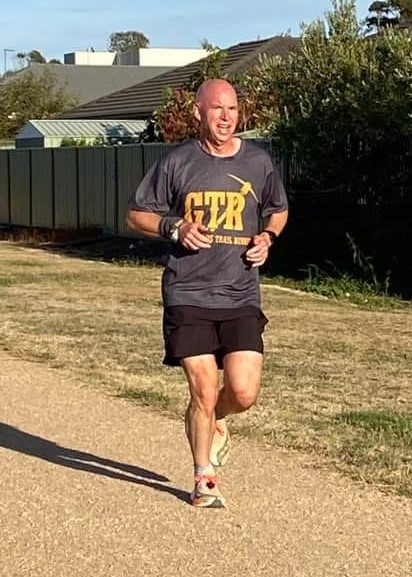
Dominique de Rooij (Dom)
Advanced Running Coach certified by Athletics Australia with 20 years of writing about running and over a decade coaching runners — from first-timers to marathoners. Dom's beginner programs have guided thousands of runners and been praised above plans from Jeff Galloway, Hal Higdon, and Runner's World. Now over 50, Dom still loves trail running, parkrun, and the coffee after.
Free weekly coaching • Join 3,500+ runners
Train Smarter, Not Just Harder
Get your free guide when you join the BRT Coaching Letter
No spam, ever. Unsubscribe in one click, any time.
What's New?
-
Personalized Running Coaching - BRT | Run Smarter, Race Better
 Get a personalized running program built around your current fitness, goals, and schedule - not a generic app template. Choose from BRT Silver, Gold, or Platinum coaching with Dom, accredited running…
 -
Sample 4-Day Marathon Training Week: Base to Taper
A full 4-day-a-week marathon training schedule, phase by phase - base, build, peak, and taper - with named workouts and weekly mileage. -
Marathon Taper for a 10-12 Week Training Cycle
How to taper correctly on a compressed 10-12 week marathon plan - the right taper length, why standard advice doesn't fit, and the week-by-week structure.