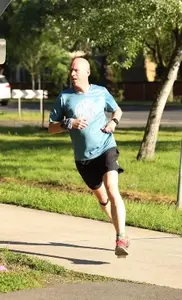
Running Form Fixes for Runner's Knee: Cadence, Stride, and Knee Alignment
Let's face it — you've been told to "fix your form," and the usual target is a single number: 180 steps per minute. No, that's not right for everyone. It's a population average, and your ideal cadence shifts with your height, leg length, and pace.I've coached runners through this exact fix more times than I can count, and the ones who get it wrong almost always make the same two mistakes — jumping straight to 180 steps per minute (spm), and consciously shortening their stride instead of letting cadence do the work for them. Let's fix both properly.
Why Running Form Matters for Knee Loading
Before the fixes, a quick word on why any of this matters for your knee.A shorter, quicker stride reduces the braking force and impact load your knee absorbs with every step — less stride, less shock. Overstriding does the opposite: landing with your foot well ahead of your hip increases the knee flexion moment at initial contact, meaning more bending force through the joint the instant you land. And hip adduction or pelvic drop — your hip dropping or rotating inward with each step — is what drives knee valgus, the inward collapse of the knee you'll have heard mentioned.
None of the fixes below are arbitrary. Each one targets a specific mechanism that's loading your knee more than it needs to.
The Cadence Fix: Target Numbers and Individual Variation
Many of us hear "180" and assume it's a strict target. It isn't. 170 to 180 steps per minute (spm) is a range drawn from studies of experienced runners — an average, not a rule.A taller runner, a runner with longer legs, or you on an easy run will naturally land lower than 180, and that's not a fault to fix. The trick is working from your own baseline, not someone else's number.
Here's how to find yours: count your steps on one foot only for 30 seconds during an easy run, then double it. That's your baseline cadence.
From there, don't jump straight to 180. Increase by 5–10% above your baseline and hold it before you consider going further. A big jump overnight asks your calves and Achilles to do work they haven't built up to yet — more on that risk shortly.
How to Actually Increase Your Cadence (Metronomes, Music, Watch Cues)
Knowing your target and hitting it are different problems, and the difference is in the detail. Here are three methods that actually work:- A metronome app set to your target cadence — start it, run to the beat, no thinking required
- A BPM-matched playlist, where the music's tempo matches your target steps per minute, so the cue is built into something you're already listening to
- Cadence feedback from a running watch, which taps or displays your real-time steps per minute so you can self-correct mid-run
This is a motor-learning task, not a one-run fix. In the runners I've coached through this, holding each increase for a few solid weeks — not days — is what separates a cadence change that sticks under fatigue from one that quietly reverts the moment you stop thinking about it.
Stride Length: Fixing Overstriding Without Overcorrecting
Overstriding looks like this: your foot lands well ahead of your hip's centre of mass, heel first, with your leg almost straight. A corrected stride lands closer under your hip, with a slight bend still in the knee.Beware overcorrecting here. Consciously shortening your stride — forcing your foot down earlier, cutting your reach — shifts load onto your calf and Achilles instead of your knee. You can trade one overuse injury for another if you force this.
The fix isn't to shorten your stride directly. It's to raise your cadence and let your stride length come down on its own, as a side effect. Change by feel, not by force — a quicker cadence naturally pulls your foot placement in under you, without you consciously reaching to make it happen.
Knee Tracking and Kneecap Alignment Cues That Actually Work
You've probably heard two cues: "point your kneecaps forward" and "don't let your knee cave in." Both are useful reminders, and both backfire when you overapply them.Force your knee outward too hard on every stride and you create an unnatural, exaggerated gait — one that trades knee valgus for a new strain through your hip or iliotibial (IT) band. A cue should be a gentle nudge, not a constant muscular effort.
Here's the honest truth: cueing alone rarely holds once you're fatigued, late in a long run or a race. What holds it is strength — specifically your glute medius and hip strength, which control how much your hip drops or rotates inward in the first place.
If you haven't already, self-test your root cause — it tells you whether hip weakness, quad dominance, or both are driving your knee's alignment, which is the difference between cueing your way through this and actually fixing it.
Trunk Lean: How Much and From Where
Lean should come from your ankles, not your waist. Tilt forward as one straight unit — ankle through hip through shoulder — rather than folding at the hips.Bend from the waist instead and you overload your lower back and hip flexors, which is a different problem you don't need on top of a sore knee.
Self-check: a straight line should run from your ankle, through your hip, to your shoulder, tilted slightly forward. See a bend at the waist in a photo or video? That's your cue to straighten up and tilt from lower down.
Self-Checking Your Form With Video or a Running Watch
Feeling like you've changed your form and actually changing it are two different things — here's how to check.Film yourself side-on, slow-motion if your phone supports it, camera at hip height, every 2–3 weeks. Look for three things: where your foot lands relative to your hip, whether your knee tracks straight or caves in on landing, and your trunk lean angle against the ankle-hip-shoulder line above.
No filming setup? A running watch that tracks cadence and ground contact time gives you a passive alternative — rising cadence and falling ground contact time over a few weeks tells you the same story the numbers can't lie about.
Pairing Form Changes With Strength Work
Form cues change your stride mechanics. They don't, on their own, make those mechanics hold once you're several miles in and tired.That's strength work's job — hip, glute, and quad strength are what keep your new cadence and alignment intact under fatigue, rather than reverting to old habits the moment your form-focus lapses. Pair form changes with a strength program so the fix actually sticks.
When to See a Doctor
Form coaching is my lane. It isn't a substitute for a clinical assessment, and I want to be upfront about where that line sits.See a doctor or physio if your pain hasn't eased within 2–3 weeks of consistent form changes and rest, if you notice swelling, if your knee locks or catches, or if the pain changes character — turning sharp, localised, or steadily worse rather than a dull ache. That's not a cueing problem anymore, and no amount of cadence or lean adjustment fixes it.
For the full breakdown of exactly when form fixes aren't enough, that's where to go next.
Frequently Asked Questions
Is 180 steps per minute really the right cadence for everyone?
No — it's a population average, not a personal target. Adjust it for your height, leg length, and pace; a taller runner or anyone on an easy run will naturally sit lower than 180.
Can changing my cadence too quickly cause a new injury?
Yes — an abrupt jump can overload your calf and Achilles before they've adapted. Increase gradually, holding each new cadence for a few weeks before the next bump.
What's the difference between "shortening stride" and "overstriding correction"?
Overstriding correction targets where your foot lands relative to your hip. Consciously shortening your stride without raising cadence first risks overcorrecting and shifting load onto your calf and Achilles instead.
Will slowing down my pace fix my knee alignment on its own?
Partially. A slower pace reduces the impact load going through your knee, but it doesn't correct valgus or overstriding by itself — you still need the cueing and strength work above.
How long does it take for a cadence change to become natural?
Typically several weeks of consistent cueing on your easy runs before it holds without conscious effort — this is a motor-learning task, not something that clicks in a single run.
None of these fixes happen in one run. Cadence, stride, alignment, and lean all take weeks of consistent cueing before they hold without you thinking about them — listen to your body here, and give the process the weeks it actually needs.
Once your form changes are holding and your strength work is underway, returning to running as your form changes hold is the natural next step.
Some Other Pages You May Like
***injuriesfooter.shtml***
What's New?
-
Personalized Running Coaching - BRT | Run Smarter, Race Better
 Get a personalized running program built around your current fitness, goals, and schedule - not a generic app template. Choose from BRT Silver, Gold, or Platinum coaching with Dom, accredited running…
 -
Sample 4-Day Marathon Training Week: Base to Taper
A full 4-day-a-week marathon training schedule, phase by phase - base, build, peak, and taper - with named workouts and weekly mileage. -
Marathon Taper for a 10-12 Week Training Cycle
How to taper correctly on a compressed 10-12 week marathon plan - the right taper length, why standard advice doesn't fit, and the week-by-week structure.